
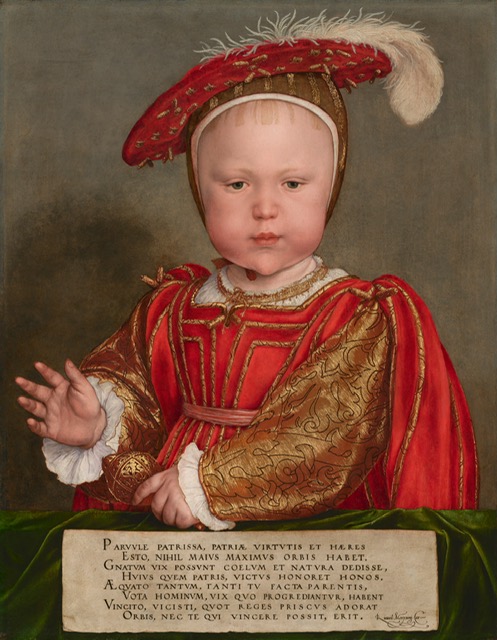
Despite the fame of Holbein's portraits, art might not be the first thing that comes to mind when we think of the Tudors. Yet from Henry VII onwards, the Tudor dynasty made unprecedented use of images and objects to promote their rule. We'll uncover the rich variety of painting, architecture, tapestry and other decorative objects that surrounded English viewers in the 16th century, putting these artworks into their religious, political, social and artistic contexts.
Lecture 1. Climbing Roses: Art for Henry VII and Henry VIII
In this lecture we consider art made during Henry VII's reign and the first two decades of Henry VIII's. As the first Tudor monarchs tried to underpin their tenuous claim to the throne, art began to play a major role in their political strategy. From portraits to coins to tapestries, the visual arts are used to express potent political and religious messages.
Lecture 2. Renaissance Moments: Edward VI and Mary I
As England's knowledge of foreign art and artists grew, hints of the Renaissance start to appear in Tudor visual art. In this lecture we look at the ways the mid-Tudor monarchs, Edward VI and Mary I, engaged with apparently 'Renaissance' trends in tapestries, book arts, architecture and paintings, in a uniquely English, hybrid, manner.
Lecture 3. Gloriana in Orbit: Elizabeth I and the Visual Arts
Although Elizabeth I was famously parsimonious, her reign ushered in a golden age of visual art. Courtiers and new-made men sought to define their social position and their relationship with the queen through visual arts. From vast prodigy houses to portrait miniatures, Elizabethans used every method at their disposal to send messages about their social status.
About our speaker:
Dr Christina Faraday FSA FRHistS is a historian of art and ideas, specialising in Tudor and Stuart Britain and the wider 16th and 17th-century world. She is an Affiliated Lecturer in History of Art at the University of Cambridge, a Trustee of the Walpole Society for British art history, and a BBC New Generation Thinker, appearing regularly on BBC Radio 3 and in other popular media. She is the host of British Art Matters podcast, and from 2020-2025 she was a Research Fellow in History of Art at Gonville and Caius College, Cambridge.
She is an experienced lecturer, teaching for the History of Art Department at the University of Cambridge, The Wallace Collection, the National Gallery, London, and for Professional and Continuing Education at Cambridge, where she is Co-Director of the MSt in History of Art and Visual Culture. Her first book, Tudor Liveliness: Vivid Art in Post-Reformation England, was published in 2023 by the Paul Mellon Centre and Yale University Press. Her latest book, The Story of Tudor Art, was published by Head of Zeus/Bloomsbury in September 2025 and was named a Times and Sunday Times Book of the Year.

People think they know Constable through images on chocolate boxes and biscuit tins but often they don’t really understand his most familiar works. The Constable Research Project (CRP) was established by Sarah Cove in 1986 to study John Constable’s oil painting materials and techniques. Initially working in collaboration with the V&A Museum and a private donor her study was widened to include fully attributed works from most UK and US east-coast galleries and private collections. To date well over 250 oils from 1799 to 1837, plus 2 paint boxes and Constables’ last pallete have been examined.
The main aim of the CRP was to deepen our understanding of Constable through a thorough study of his working methods and materials.
Lecture 1 and 2: In a roughly chronological presentation Sarah will show the highlights of her research including many famous oil sketches, the six-foot canvasses and his extraordinary late oils. Her talk demonstrates the effectiveness of an in-depth study of the work of a single artist in terms of developing a secure chronology through the dating of materials and techniques and how this acts as an aid to attribution, Since her appearances on Fake or Fortune, Sarah has been instrumental in the discovery of more than a dozen ‘new’ Constables in the past few years.
Lecture 3: A Tale of Vanity Fair: Constable’s Treslove Portraits Re-discovered
Until 2019 the whereabouts of Constable’s sumptuous portrait of his neighbour in Charlotte Street, Mrs Emily Treslove (1826 -29) (Private Collection) was unknown. It had come down through five generations of her family to the present owners along with a volume of her diaries and a jewel from the flashy parure of garnet and pearl jewellery that she wears. The painting of Emily in all her finery is arguably one of Constable’s finest portraits. Following the discovery, a completely unknown companion portrait of her husband, Thomas Treslove QC (1775 – 1841) came to light, also in the family collection painted four years earlier in 1822.
This lecture reveals an intriguing story of extreme wealth, vanity, high fashion, politic and nepotism in Regency Society as Sarah follows Emily’s ambition and Thomas’ Carrer into the Victorian age. We see how the technical study of Constables painting, alongside his own letters and the sitter’s revealing diaries, widens our understanding of his portrait practice and the frivolity of the nouveau riche in the early 19th century.
About our speaker:
Sarah Cove ACR, FIIC, FBAPCR is an Accredited paintings conservator-restorer, technical art historian and lecturer with almost 40 years’ experience working on paintings for the heritage and private sectors. She lives and works in Falmouth, Cornwall, but also has a permanent base in London. As a conservator, she specialises in British portraiture, 19th-20th century British landscapes and oil sketches on paper and board. Alongside her conservation practice, in 1986 Sarah founded the Constable Research Project and she is now the leading authority on Constable’s oil painting materials and techniques. She has appeared in several TV programmes for the BBC notably Constable in Love with Andrew Graham-Dixon and twice on Fake or Fortune? where she was instrumental in the discovery of 3 ‘lost’ Constables. Other research interests include Tudor and Jacobean Portraiture, the 19th century Newlyn and St Ives schools and early-to-mid 20th century British painting generally. She has been a lecturer for The Arts Society since 2003 and is a very experienced speaker having lectured independently since the 1980s at major public venues across the UK, USA, Australia and New Zealand. Her presentations are lively and enthusiastic as she speaks without notes with an inimitable passion that comes from presenting her own work and research with wonderful images.
Sarah's professional website has lots of interesting information about her work, lectures and research. In June 2023 Sarah was interviewed by BBC local radio to promote her lecture for The Arts Society Guernsey following the discovery of a small Constable oil sketch (photo).

This study day provides a fascinating introduction to some of the finest Nordic art and design, by looking at important genres and periods in a completely new way. It covers how the Scandinavian foundation story – Norse Mythology – has been portrayed in art. Then it looks at the most fertile period in Nordic painting, the ‘Modern Breakthrough’ between 1880 and 1920, concentrating on superb works of the women who reached the heights of the Nordic art world. The afternoon focuses on design, for which the region is famed, and in particular the ‘Scandinavian Modern’ movement between 1930 and 1960. But each of these topics hides strange and dark mysteries that will be solved during the course of the day:
Lecture 1: Why do we so rarely see the Norse gods and goddesses in art when the Greek and Roman pagan deities are portrayed everywhere?
Lecture 2: Why were Nordic women painters overlooked in Western art…and why are they making a comeback now?
Lecture 3: What lay beneath the surface of the Scandinavian Modern design movement? How could the region’s taste change so completely in just thirty years?
About our speaker:
James Vaux is a researcher and lecturer in Nordic arts, culture, design and history. An Oxford graduate, he had a career in law and banking, living and working in Scandinavia as Head of the Nordic Region for Rothschild & Co. James subsequently took an MA at UCL in Scandinavian Studies (Culture and History). He studied interior design and art history at the Inchbald School and Mid-Century Modern at Sotheby's Institute. He is now a popular, and highly rated, Accredited Lecturer of The Arts Society. James regularly travels across the Nordics, visiting and researching the homes and colonies of artists, writers, designers and musicians to provide first hand insights into their lives and works. He is also a member of euroart, the confederation of European Artists' Colonies.